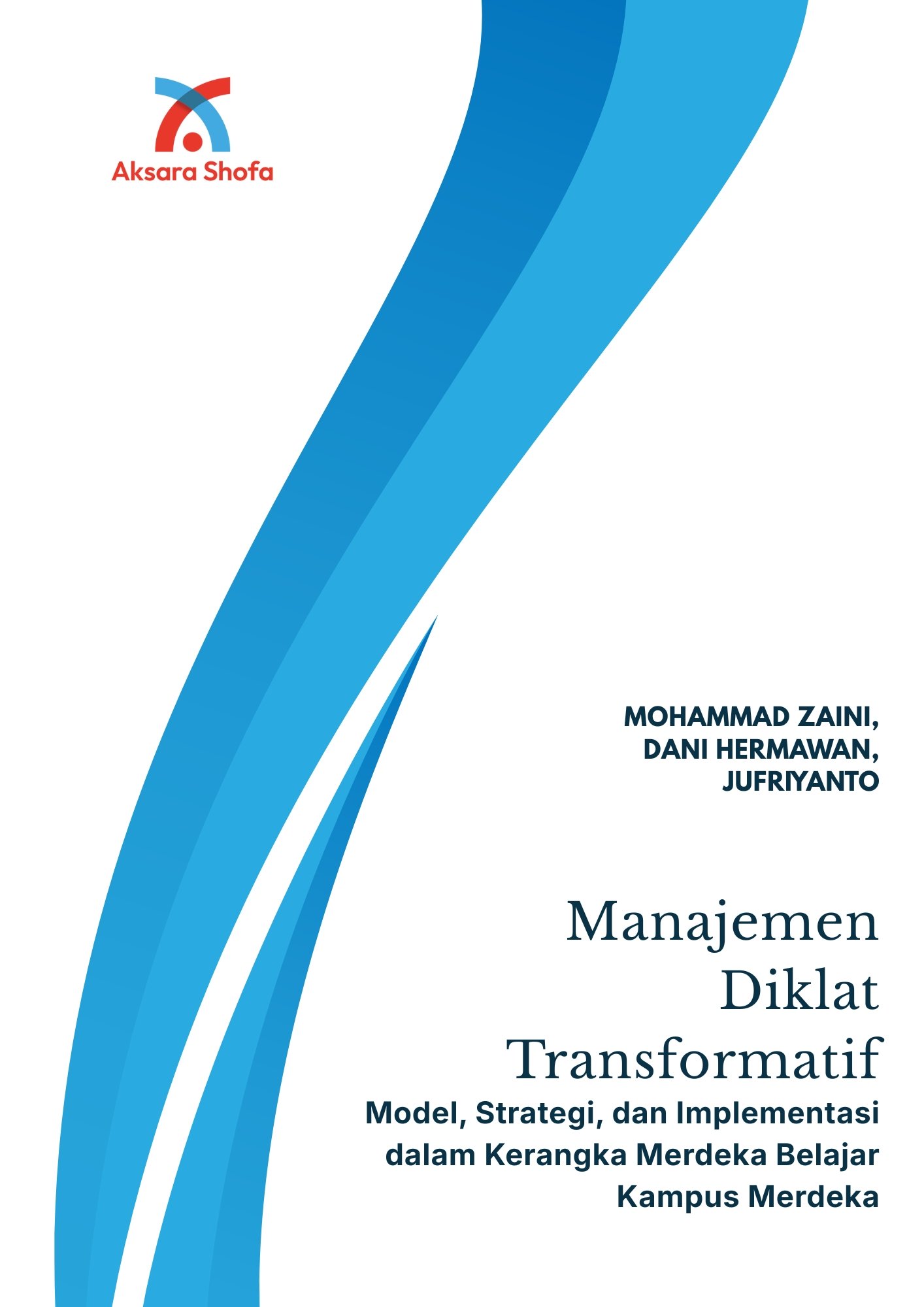
Manajemen Diklat Transformatif: Model, Strategi, Dan Implementasi Dalam Kerangka Merdeka Belajar–Kampus Merdeka
DOI:
https://doi.org/10.62523/aksarashofa.6Abstract
Buku Manajemen Diklat Transformatif: Model, Strategi, dan Implementasi dalam Kerangka Merdeka Belajar–Kampus Merdeka disusun untuk memberikan pemahaman komprehensif mengenai manajemen pendidikan dan pelatihan (diklat) sebagai proses pembelajaran yang tidak hanya bersifat teknis dan administratif, tetapi juga berorientasi pada pengembangan manusia secara utuh. Buku ini menempatkan diklat sebagai instrumen strategis dalam menjawab tantangan pendidikan abad ke-21 yang ditandai oleh dinamika sosial, kemajuan teknologi, serta tuntutan dunia kerja yang semakin kompleks.
Pembahasan dalam buku ini menekankan pentingnya pengembangan keterampilan abad ke-21—meliputi berpikir kritis, kreativitas, kolaborasi, dan komunikasi—melalui desain pembelajaran yang berpusat pada peserta, berbasis pengalaman, dan kontekstual. Selain itu, buku ini menggarisbawahi peran kolaboratif aktor pendidikan, yaitu dosen, mahasiswa, dan peserta didik, dalam menciptakan sistem diklat yang partisipatif, reflektif, dan berkelanjutan.
Dalam kaitannya dengan kebijakan Merdeka Belajar–Kampus Merdeka (MBKM), buku ini menunjukkan relevansi manajemen diklat sebagai jembatan antara dunia akademik dan realitas sosial melalui program-program pembelajaran kontekstual dan pengabdian kepada masyarakat. Puncak kajian buku ini adalah perumusan Model Manajemen Diklat Transformatif yang disusun berdasarkan landasan filosofis, teoretis, dan empiris, serta dirancang sebagai siklus pembelajaran berkelanjutan yang mencakup analisis kebutuhan, perencanaan, pelaksanaan, monitoring, evaluasi, dan refleksi.
Secara keseluruhan, buku ini menawarkan pendekatan manajemen diklat yang transformatif dan kontekstual sebagai upaya strategis untuk meningkatkan kualitas pendidikan dan pelatihan. Buku ini diharapkan menjadi rujukan akademik dan praktis bagi mahasiswa, dosen, pengelola diklat, serta pemangku kepentingan pendidikan dalam mengembangkan program diklat yang bermakna, adaptif, dan berkelanjutan.
References
Alhaddad, I. (2012). PENERAPAN TEORI PERKEMBANGAN MENTAL PIAGET PADA KONSEP KEKEKALAN PANJANG. Infinity Journal, 1(1), 31–44. https://doi.org/10.22460/infinity.v1i1.p31-44
Anderson, G. L., & Middleton, E. B. (2014). LeaderPAR: A Participatory Action Research Framework for School and Community Leadership. Dalam I. Bogotch & C. M. Shields (Ed.), International Handbook of Educational Leadership and Social (In)Justice (hlm. 275–287). Springer Netherlands. https://doi.org/10.1007/978-94-007-6555-9_16
Anthony, G. (1996). Active learning in a constructivist framework. Educational Studies in Mathematics, 31(4), 349–369. https://doi.org/10.1007/BF00369153
Arora, W., Erlamsyah, E., & Syahniar, S. (2013). HUBUNGAN ANTARA PERLAKUAN ORANGTUA DENGAN KEMANDIRIAN SISWA DALAM BELAJAR. Konselor, 2(1). https://doi.org/10.24036/02013211252-0-00
Badia, J. D. (2017). Creative Project-based learning to boost technology innovation. @tic Revista d’innovació Educativa, 18, Article 18. https://doi.org/10.7203/attic.18.9019
Baldassarre, G., & Mirolli, M. (Ed.). (2013). Intrinsically Motivated Learning in Natural and Artificial Systems. Springer Berlin Heidelberg. https://doi.org/10.1007/978-3-642-32375-1
Boyko, M. (2019). Студентоценроване навчання в процесі управління якістю професійної підготовки майбутнього вчителя. ScienceRise: Pedagogical Education, 4 (31), Article 4 (31). https://doi.org/10.15587/2519-4984.2019.176797
Brown, N. J. S., Furtak ,Erin Marie, Timms ,Michael, Nagashima ,Sam O., & and Wilson, M. (2010). The Evidence-Based Reasoning Framework: Assessing Scientific Reasoning. Educational Assessment, 15(3–4), 123–141. https://doi.org/10.1080/10627197.2010.530551
Budilaksono, D. S., Kom, M., Febrianty, D., Rosadi, D. A., Kom, M., Dewi, D. E. P., Nurzaman, F., & Suwartane, I. G. A. (2021). IMPLEMENTASI MERDEKA BELAJAR – KAMPUS MERDEKA (MBKM) PADA PROGRAM MATCHING FUND. Perkumpulan Rumah Cemerlang Indonesia.
Bylkova, S., Chubova, E., & Kudryashov, I. (2021). Public speaking as a tool for developing students’ communication and speech skills. E3S Web of Conferences, 273, 11030. https://doi.org/10.1051/e3sconf/202127311030
Cahyani, N. K. C. (2021). The Effectiveness of Project-Based Learning Models in Improving Students’ Creativity (A Literature Review). The Art of Teaching English as a Foreign Language (TATEFL), 2(1), 73–77. https://doi.org/10.36663/tatefl.v2i1.107
Castillo, F. G. (2020). Innovative Pedagogy for Higher Educational Institution: The Teacher Point of View. Dalam A. N. Al-Masri & Y. Al-Assaf (Ed.), Sustainable Development and Social Responsibility—Volume 2 (hlm. 95–103). Springer International Publishing. https://doi.org/10.1007/978-3-030-32902-0_13
Cobo, C. (2013). Skills for innovation: Envisioning an education that prepares for the changing world. The Curriculum Journal, 24(1), 67–85. https://doi.org/10.1080/09585176.2012.744330
Coers, N., Lorensen, M., & Anderson, J. C. (2009). Case Study: Student Perceptions of Groups & Teams in Leadership Education. Journal of Leadership Education, 8(1), 93–110. https://doi.org/10.12806/V8/I1/RF1
Daniel, A. D. (2016). Fostering an entrepreneurial mindset by using a design thinking approach in entrepreneurship education. Industry and Higher Education, 30(3), 215–223. https://doi.org/10.1177/0950422216653195
Dantley, M. E. (1990). The Ineffectiveness of Effective Schools Leadership: An Analysis of the Effective Schools Movement from a Critical Perspective. The Journal of Negro Education, 59(4), 585–598. https://doi.org/10.2307/2295315
Dillenbourg, P. (1999). What do you mean by collaborative learning? (hlm. 1). Elsevier. https://telearn.hal.science/hal-00190240
Duckworth, A. L. (2009). Self-Discipline is Empowering. Phi Delta Kappan, 90(7), 536–536. https://doi.org/10.1177/003172170909000720
Garcez, A., Franco, M., & Silva, R. (2022). The soft skills bases in digital academic entrepreneurship in relation to digital transformation. Innovation & Management Review, 20(4), 393–408. https://doi.org/10.1108/INMR-07-2021-0135
García, L. M., Deserti, A., & Teixeira, C. (2017). Entrepreneurial design: The role of design as driver of entrepreneurial opportunity generation and assessment. International Journal of Entrepreneurship and Innovation Management, 21(1/2), 64. https://doi.org/10.1504/IJEIM.2017.081494
Gupta, S. (2011). Constructivism as a paradigm for teaching and learning. International Journal of Physical and Social Sciences, 1(1), 23–47.
Hamrin, S. (2016). Communicative leadership and context: Exploring constructions of the context in discourses of leadership practices. Corporate Communications: An International Journal, 21(3), 371–387. https://doi.org/10.1108/CCIJ-09-2015-0056
Hutapea, E. R. & Tuti Atika. (2023). Teaching Campus as A Mean for Improving Primary School Creativity: (Kampus Mengajar Sebagai Wadah Peningkatan Kreativitas Sekolah Dasar). SOSMANIORA: Jurnal Ilmu Sosial dan Humaniora, 2(4), 465–471. https://doi.org/10.55123/sosmaniora.v2i4.2641
Idrus, H. (2016). Enhancing Oral Presentation Skills of ESL Students: The Use of Oral Communication Strategies. Dalam S. F. Tang & L. Logonnathan (Ed.), Assessment for Learning Within and Beyond the Classroom (hlm. 437–446). Springer. https://doi.org/10.1007/978-981-10-0908-2_37
Indrawatiningsih, N. (2017). Arguments in Critical Thinking Ability. 12–15. https://doi.org/10.2991/icomse-17.2018.4
Kalyvas, S. N. (2008). Collaboration in comparative perspective. European Review of History: Revue européenne d’histoire, 15(2), 109–111. https://doi.org/10.1080/13507480801931036
Karlqvist, A. (1997). Creativity. Some Historical Footnotes from Science and Art. Dalam Å. E. Andersson & N.-E. Sahlin (Ed.), The Complexity of Creativity (hlm. 105–114). Springer Netherlands. https://doi.org/10.1007/978-94-015-8788-4_10
Khabanyane, K. E., Maimane, J. R., & Ramabenyane, M. J. (2014). A Critical Reflection on Transformative Learning as Experienced by Student-Teachers during School-Based Learning. Mediterranean Journal of Social Sciences, 5(27 P1), Article 27 P1.
Khan, S. H. (2013). Constructivism: An innovative inquiry-based approach to classroom teaching; with special reference to teaching of science. GYANODAYA-The Journal of Progressive Education, 6(1), 60–69.
Knowles, M. S. (1973). The Adult Learner: A Neglected Species. Gulf Publishing Company.
Kons, A. W., M. Pd. (2022). Merdeka Belajar dan Implementasinya: Merdeka GuruSiswa, Merdeka DosenMahasiswa, Semua Bahagia. Elex Media Komputindo.
Korinek, L., Walther-Thomas, C., McLaughlin, V. L., & Toler Williams, B. (1999). Creating Classroom Communities and Networks for Student Support. Intervention in School and Clinic, 35(1), 3–8. https://doi.org/10.1177/105345129903500101
Kozulin, A. (2015). Vygotsky’s Theory of Cognitive Development. Dalam J. D. Wright (Ed.), International Encyclopedia of the Social & Behavioral Sciences (Second Edition) (hlm. 322–328). Elsevier. https://doi.org/10.1016/B978-0-08-097086-8.23094-8
Leighton, R. H., & and Griffioen, D. M. E. (2023). Lecturers’ curational behaviour in higher education. Teaching in Higher Education, 28(6), 1207–1226. https://doi.org/10.1080/13562517.2021.1872530
Margaret, G. D., Kirubakar, S. G., & Kumutha, N. (2010). Communication skills: A cognitive–behavioural approach to enhance relationship skills in young sport coaches. British Journal of Sports Medicine, 44(Suppl 1), i49–i50. https://doi.org/10.1136/bjsm.2010.078725.166
Mendes, I. A. C. (2005). Liderando com mentalidade flexível. Revista Latino-Americana de Enfermagem, 13, 463–463. https://doi.org/10.1590/S0104-11692005000400001
Mergler, A. G., Spencer, F. H., & Patton, W. (2008). Personal Responsibility: The creation, implementation and evaluation. The Journal of Student Wellbeing, 2(1), Article 1. https://doi.org/10.21913/JSW.v2i1.167
Mezirow, J. (1997). Transformative Learning: Theory to Practice. New Directions for Adult and Continuing Education, 1997(74), 5–12. https://doi.org/10.1002/ace.7401
Muhid, A. (2021). Heutagogi: Memerdekakan mahasiswa belajar di era revolusi digital. Inteligensia Media. http://repository.uinsa.ac.id/id/eprint/1718/
Mulyani, A. Y. (2022). Pengembangan Critical Thinking Dalam Peningkatan Mutu Pendidikan di Indonesia. DIAJAR: Jurnal Pendidikan Dan Pembelajaran, 1(1), Article 1. https://doi.org/10.54259/diajar.v1i1.226
Murtadho, M. I., Rohmah, R. Y., Jamilah, Z., & Furqon, M. (2023). The Role Of Digital Literacy In Improving Students’ Competence In Digital Era. AL-WIJDÃN Journal of Islamic Education Studies, 8(2), 253–260. https://doi.org/10.58788/alwijdn.v8i2.2328
Nutter, J. T. (1987). ASSIMILATION: A strategy for implementing self-reorganizing knowledge bases. Proceedings of the sixth National conference on Artificial intelligence - Volume 2, 449–453.
Nweke, C. C., & Owoh, A. T. (2020). On pedagogy of the oppressed: An appraisal of Paulo Freire’s philosophy of education. OGIRISI: A New Journal of African Studies, 16, 62–75. https://doi.org/10.4314/og.v16i1.4
O’Neill, G., & McMahon, T. (2005). Student-centred learning: What does it mean for students and lecturers (Vol. 1). Dublin: AISHE. http://www.aishe.org/readings/2005-1/oneill-mcmahon-Tues_19th_Oct_SCL.html
Osborne, C. (2018). Programming to Promote Information Literacy in the Era of Fake News (SSRN Scholarly Paper No. 3167897). Social Science Research Network. https://doi.org/10.2139/ssrn.3167897
Price, J. P. (1991). Effective Communication: A Key to Successful Collaboration. Preventing School Failure: Alternative Education for Children and Youth, 35(4), 25–28. https://doi.org/10.1080/1045988X.1991.9944255
Purbojo, R. (2018). Role of the University Lecturer in an Online Learning Environment: An Analysis of Moodle Features Utilized in a Blended Learning Strategy. Dalam K. A. Persichitte, A. Suparman, & M. Spector (Ed.), Educational Technology to Improve Quality and Access on a Global Scale: Papers from the Educational Technology World Conference (ETWC 2016) (hlm. 227–244). Springer International Publishing. https://doi.org/10.1007/978-3-319-66227-5_18
Putra, Y. P. (2024). Analisis Apersepsi dan Pengalaman Mahasiswa dalam Merealisasikan Program Kampus Mengajar 3 di SD Negeri 115/IV Kota Jambi [Other, UNIVERSITAS JAMBI]. https://repository.unja.ac.id
Rahmawati, Y., Supriatna, E., & Yuliani, W. (2022). VALIDITAS DAN RELIABILTAS ANGKET KEMANDIRIAN BELAJAR SISWA SMP. FOKUS : Kajian Bimbingan Dan Konseling Dalam Pendidikan, 5(3), Article 3. https://doi.org/10.22460/fokus.v5i3.7260
Ramoglou, S., & Zyglidopoulos, S. C. (2015). The constructivist view of entrepreneurial opportunities: A critical analysis. Small Business Economics, 44(1), 71–78. https://doi.org/10.1007/s11187-014-9590-4
Roth, B. F. (2000). Student Learning in the Information Age. The Journal of Higher Education. https://www.tandfonline.com/doi/abs/10.1080/00221546.2000.11780831
Rusbult, C. E., Verette, J., Whitney, G. A., Slovik, L. F., & Lipkus, I. (1991). Accommodation processes in close relationships: Theory and preliminary empirical evidence. Journal of Personality and Social Psychology, 60(1), 53–78. https://doi.org/10.1037/0022-3514.60.1.53
Saavedra, A. R., & Opfer, V. D. (2012). Learning 21st-Century Skills Requires 21st-Century Teaching. Phi Delta Kappan, 94(2), 8–13. https://doi.org/10.1177/003172171209400203
Samani, M., Sunwinarti, S., Putra, B. A. W., Rahmadian, R., & Rohman, J. N. (2019). Learning Strategy to Develop Critical Thinking, Creativity, and Problem-Solving Skills for Vocational School Students. Jurnal Pendidikan Teknologi Dan Kejuruan, 25(1), Article 1. https://doi.org/10.21831/jptk.v25i1.22574
Sawyer, R. K. (2010). Learning for Creativity. Dalam J. C. Kaufman & R. A. Beghetto (Ed.), Nurturing Creativity in the Classroom (hlm. 172–190). Cambridge University Press. https://doi.org/10.1017/CBO9780511781629.009
Schullery, N. M., & Gibson, M. K. (2001). Working in Groups: Identification and Treatment of Students’ Perceived Weaknesses. Business Communication Quarterly, 64(2), 9–30. https://doi.org/10.1177/108056990106400202
Shipp, S., Lamb Jr.,Charles W., & and Mokwa, M. P. (1993). Developing and Enhancing Marketing Students’ Skills: Written and Oral Communication, Intuition, Creativity, and Computer Usage. Marketing Education Review, 3(3), 2–8. https://doi.org/10.1080/10528008.1993.11488418
Sintiawati, N., Fajarwati, S. R., Mulyanto, A., Muttaqien, K., & Suherman, M. (2022). Partisipasi Civitas Akademik dalam Implementasi Merdeka Belajar Kampus Merdeka (MBKM). Jurnal Basicedu, 6(1), 902–915. https://doi.org/10.31004/basicedu.v6i1.2036
Sisola, S. (2004). Learning as Transformation: Critical Perspectives on a Theory in Progress. Journal of Physical Therapy Education, 18(2), 95.
Slavin, R. E. (1990). Cooperative Learning: Theory, Research, and Practice. Prentice Hall.
Tomlinson, C. A. (1993). Independent Study: A Flexible Tool for Encouraging Academic and Personal Growth. Middle School Journal, 25(1), 55–59. https://doi.org/10.1080/00940771.1993.11495190
Weeks, P. P., & Kelsey, K. D. (2007). Student Project Teams: Understanding Team Process through an Examination of Leadership Practices and Team Culture. Journal of Leadership Education, 6(1), 209–225. https://doi.org/10.12806/V6/I1/RF11
West, M. A., & Sacramento, C. A. (2012). Chapter 15 - Creativity and Innovation: The Role of Team and Organizational Climate. Dalam M. D. Mumford (Ed.), Handbook of Organizational Creativity (hlm. 359–385). Academic Press. https://doi.org/10.1016/B978-0-12-374714-3.00015-X
Windschitl, M. (2002). Framing Constructivism in Practice as the Negotiation of Dilemmas: An Analysis of the Conceptual, Pedagogical, Cultural, and Political Challenges Facing Teachers. Review of Educational Research, 72(2), 131–175. https://doi.org/10.3102/00346543072002131
Yasnitsky, A. (2011). Vygotsky Circle as a Personal Network of Scholars: Restoring Connections Between People and Ideas. Integrative Psychological and Behavioral Science, 45(4), 422–457. https://doi.org/10.1007/s12124-011-9168-5
Yoo, E. H. (2013). Theological Reflection on Mezirow’s Transformative Learning Theory. Journal of Christian Education & Information Technology, 24, 133–158.
Zaini, R. M., Elmes, M. B., Pavlov, O. V., & Saeed, K. (2019). Organizational Dissent Dynamics in Universities: Simulations With a System Dynamics Model. Management Communication Quarterly, 33(3), 419–450. https://doi.org/10.1177/0893318919846625
Zimmerman, B. J. (2000). Chapter 2 - Attaining Self-Regulation: A Social Cognitive Perspective. Dalam M. Boekaerts, P. R. Pintrich, & M. Zeidner (Ed.), Handbook of Self-Regulation (hlm. 13–39). Academic Press. https://doi.org/10.1016/B978-012109890-2/50031-7
Downloads
Published
Issue
Section
License
Copyright (c) 2026 Mohammad Zaini, Dani Hermawan, Jufriyanto

This work is licensed under a Creative Commons Attribution-NonCommercial-NoDerivatives 4.0 International License.